"Field Course in Conservation Biology & Global Health: At the Human Environment Interface'' concluded
चैत १६, २०८०, शुक्रबार | दिउँसो ०१:४९ बजे | 80
Reported by Er. Ritu Giri
Lalitpur
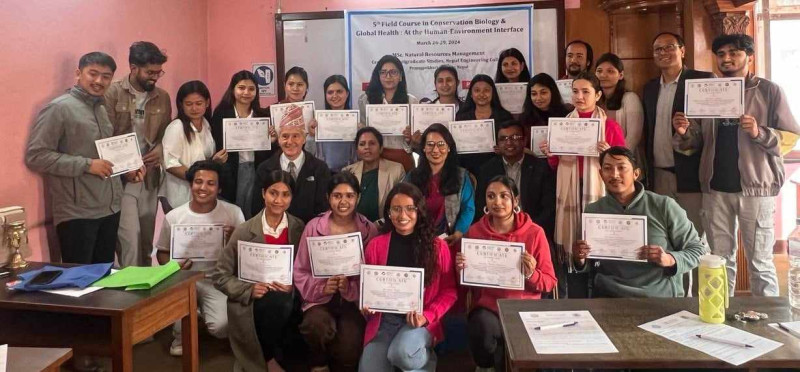
The 5th Annual "Field Course in Conservation Biology & Global Health: At the Human Environment Interface'' concluded today at Nepal Engineering College, Lalitpur. The event was graced by the presence of Ms. Manjali Shakya Bajracharya, the Deputy Mayor of the Metropolis as the chief guest, alongside Er. Durgaprasad Bhandari (Principal) and Dr. Thusitha Chandani Shahi (Director) of Nepal Engineering College. Organized by the Natural Resources Management Program of Nepal Engineering College and the Washington National Primate Research Center of the University of Washington, the course received support from the One Earth Institute, DESE - Kathmandu University, and Tribhuvan University. Prof. Randall C. Kyes (PhD) from the University of Washington led the 5-day field course, covering concepts of the Human-Environment Interface. Dr. Narayan Prasad Koju, the Coordinator of MSc. Natural Resources Management, at NEC-CPS, facilitated the felicitation program. Twenty-two participants from 11 institutions and 6 universities of Nepal, from diverse academic and professional backgrounds, including environmental science, zoology, forestry, botany, resource management, and engineering, engaged in the 5-day field course, gaining insights into the disciplines of conservation biology and global health. The curriculum delved into various aspects of the human-environment interface, encompassing field study methods, conservation strategies, wildlife conservation in Nepal, global health issues, translational science, and more. Participants also received hands-on experience with field exercises and exposure to different field study technologies. Nine professors and experts from various fields and backgrounds served as supporting instructors for the course, delivering presentations on relevant topics. As the chief guest, Ms. Manjali Shakya Bajracharya extended her congratulations to all the participants for successfully completing the program. She emphasized the significance of interdisciplinary field courses in today's world and encouraged all participants to apply the knowledge gained from the field course in their professional and academic endeavors. She urged participants to seize opportunities for cross-institutional collaboration, emphasizing that collective action is essential for driving meaningful change and advancing societal progress. Additionally, she underscored the importance of personal growth, highlighting the need for individuals to continually strive for qualitative improvement in various aspects of their lives. Three participants, namely Mr. Nishan Limbu, a graduate student from the Central Department of Zoology (TU), Ms. Shreeya Adhikari, a graduate student of Environmental Science (KU), and Er. Ritu Giri, a Civil Engineering graduate from Nepal Engineering College (PU), shared their experiences from the field course. They all conveyed that the course had been highly beneficial, providing them with valuable insights into conservation biology and global health. Additionally, each participant offered their unique perspective, reflecting the diverse academic backgrounds they came from and also highlighted the value of collaboration and expressed eagerness for future programs with similar interdisciplinary approaches. The major takeaway from the 5-day field course, as shared by the participants, is that human activities continue to impact nature and its components. While moving towards development and implementing infrastructure projects, policymakers and strategists can sometimes underestimate or fail to fully consider the repercussions on wildlife and the natural environment. Such activities can disrupt habitats, fragment ecosystems, and alter natural landscapes, posing significant threats to biodiversity. To address these challenges and promote a more harmonious relationship between human activities and wildlife, it is imperative to foster cross-disciplinary collaboration and engage in meaningful discussions among environmentalists, engineers, urban planners, policymakers, and local communities. Dr. Thusitha Chandani Shahi, the Director of Nepal Engineering College, wrapped up the program by emphasizing the critical role of active youth engagement in integrative programs. She underscored the importance of knowledge sharing sessions and collaboration among multiple universities to facilitate comprehensive knowledge exchange and highlighted the significance of such collaborative efforts in addressing contemporary challenges and fostering innovation. The presence and enthusiasm displayed by participants from diverse backgrounds underscore the potential for such interdisciplinary planning and cross-collaboration, which are crucial for fostering a holistic perspective and achieving sustainable coexistence. During the event, Ms. Manjali Shakya Bajracharya further encouraged all participants to embrace knowledge sharing for addressing the complex challenges at the human-environment interface, thereby fostering a better future for both society and the natural world.
फाेटाेमा हेर्नुहाेस्...


Comments



.jpg)