The Bhutan Watch Launches the Bhutan Democracy Digital Archive in Memory of Dr Govinda Rizal on the Second Anniversary of His Passing
बैशाख २२, २०८३, मङ्गलबार | राति ०७:२५ बजे | 105
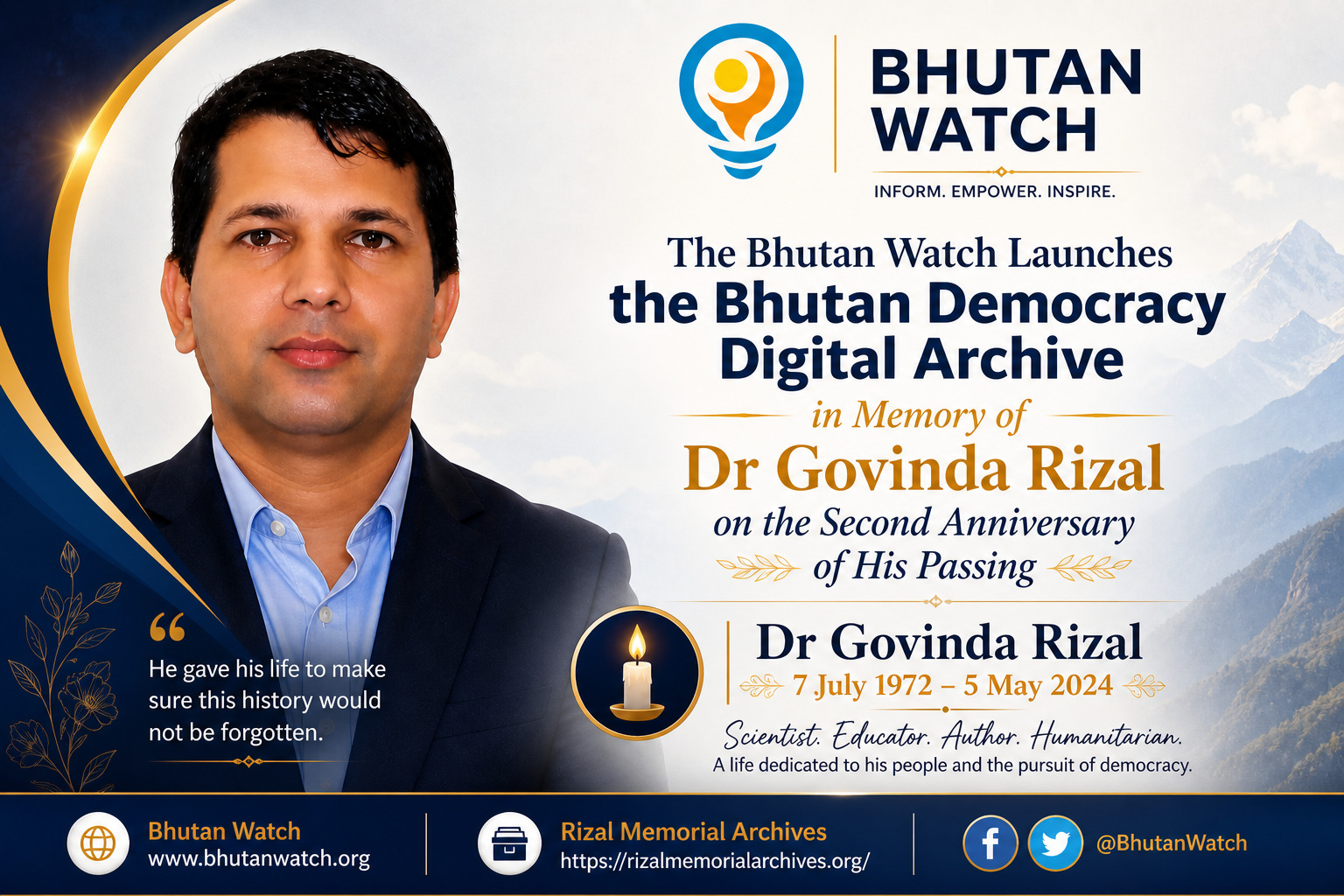
The Bhutan Watch today announces the launch of the Bhutan Democracy Digital Archive, an initiative dedicated to monitoring democratic practice in Bhutan and preserving the history of the country's long struggle for democracy. The announcement falls on the second anniversary of the death of Dr Govinda Rizal, PhD, a scientist, educator, author and long-serving co-editor of The Bhutan Journal. The archive is dedicated to his memory.
Dr. Rizal was the first to propose the idea of the archive, introducing it within The Bhutan Watch team and playing a central role in shaping its early direction. Although he passed away suddenly in May 2024, the work he set in motion did not stop. The team carried his vision forward in his memory, and after two years of sustained effort, the archive is now ready to be formally launched.
Dr Rizal passed away on 5 May 2024 following a road accident in Kirtipur, Kathmandu. He was born in Bhutan and was forced from his homeland in the early 1990s. He chose to remain in Nepal over resettlement abroad, believing that his life held greater purpose there among his people. That decision spoke to everything that defined him. He was a man who put his community before his own comfort and who never stopped working for those who had been left behind.
As a scientist specialising in rice breeding and molecular biology, Dr Rizal contributed to research that improved food security for communities in Nepal and the Philippines. As a teacher in the refugee camps of the 1990s, he became a figure of great warmth and inspiration to a generation of young Bhutanese who had little else to hold on to. His mathematical ability was legendary among his students. He published A Paradesi in Paradise, an autobiographical account of his own journey that also offered one of the most clear-eyed analyses of Bhutan's political condition written from within the community, and Bejod Bandha, a collection of stories in Nepali. At the time of his death, he was working on a comprehensive history of Bhutan, a manuscript that The Bhutan Watch hopes will be published in due course.
As co-editor of The Bhutan Journal, he created a platform for scholarly discussion and debate on the issues associated with Bhuta and the Bhutanese diaspora. He treated everyone he met with the same warmth and respect, regardless of age or background. His absence is felt deeply.
The Bhutan Watch maintains the Rizal Memorial Archives, a dedicated online repository at rizalmemorialarchives.org, which is devoted to preserving the life, work and legacy of Dr Rizal. We appeal to everyone who knew him to contribute and continue expanding this repository. Whether you were a student, he taught in the camps, a colleague from his years of research, a fellow activist, a reader of his books or simply someone who crossed his path and remembered him, your account matters. Personal tributes, written memories, photographs, letters, articles, academic correspondence, and any other materials connected to his life are all welcome. The archive belongs to the community and should reflect the full breadth of the man it commemorates.
The Bhutan Democracy Digital Archive will further cement the commemoration of Dr Rizal. The repository will document the ongoing democratic cultures and practices in Bhutan in five broad categories – political pluralism, inclusion & diversity, judiciary & rule of law, civil society including media and governance.
A healthy democracy requires real political choice, which depends on parties being able to form, operate, and express diverse ideas freely, and on citizens participating in elections with trust, engagement, and a sense of legitimacy. By collecting documents on party dynamics, legal environments, electoral laws, voter participation, and election management, this archive will help assess whether Bhutan’s electoral system remains inclusive, competitive, and transparent.
A democracy’s strength depends not just on its institutions, but on who is included in them, which is why documenting political, ethnic, religious, and gender representation is essential to assessing democratic health. The inclusion and diversity stream summarises both the progress made and the structural barriers that still limit full inclusion.
An independent judiciary is essential to a functioning democracy because it protects rights and ensures the government follows the law, which is why the archive will document judicial appointments, safeguards, transparency, and any signs of political influence. By preserving key laws and legal developments—both those that expanded freedoms and those that restricted them—the archive will show how Bhutan’s legal framework has shaped democratic life over time.
Free speech, civil society, and independent journalism are core to a functioning democracy, which is why the archive documents how freely people can organise, report, and speak without interference. By gathering evidence on media freedom, civil society laws, human rights institutions, UN review processes, and recorded rights violations, it provides a clear picture of how well people in Bhutan are protected and how much democratic space they truly have.
And the final stream governance will document how power is exercised in Bhutan by tracking who has held leadership roles, how complaints and grievances are handled, and where corruption or misuse of authority has been recorded. By compiling materials on accountability systems, ethical breaches, and anticorruption mechanisms, it will provide a clear picture of transparency and responsibility within the executive and bureaucracy.
The archive will also have a repository of the documents that tell the story of democratic struggles in Bhutan. Bhutan’s peaceful and orderly transition to parliamentary democracy in 2008 is not wrong but is incomplete. The upheavals of the 1950s, 1980s and 1990s have historical significance that has never been adequately documented or acknowledged.
The archive will bring together primary sources covering this full history, from the early movements through to the years in the refugee camps in Nepal, the long effort to secure repatriation, the eventual resettlement.
The archive does not take sides or publish opinions. It gathers documents, photographs, recordings, and reports and makes them available so that researchers, students, policymakers, and the public can read the evidence and draw their own conclusions. Special care will be taken to preserve fragile and endangered materials held by individuals and diaspora communities, and oral histories will be collected with the full and informed consent of those involved.
The Bhutan Watch also invites contributions to the Bhutan Democracy Digital Archive. If you hold documents, letters, photographs, recordings, personal accounts or any records relevant to Bhutan's democratic history or ongoing democratic practices, please do come forward. This archive is not a finished project. It is a living collection that will grow as new materials come to light, and it depends on the generosity and participation of the wider Bhutanese community and all those who care about this history.
All contributions and enquiries should be sent to editor@bhutanwatch.org or bhutanwatchresearch@gmail.com.
Bikram Adhikari
Coordinator
Bhutan Democracy Digital Archive
Ram Karki
Chairperson
The Bhutan Watch


Comments