

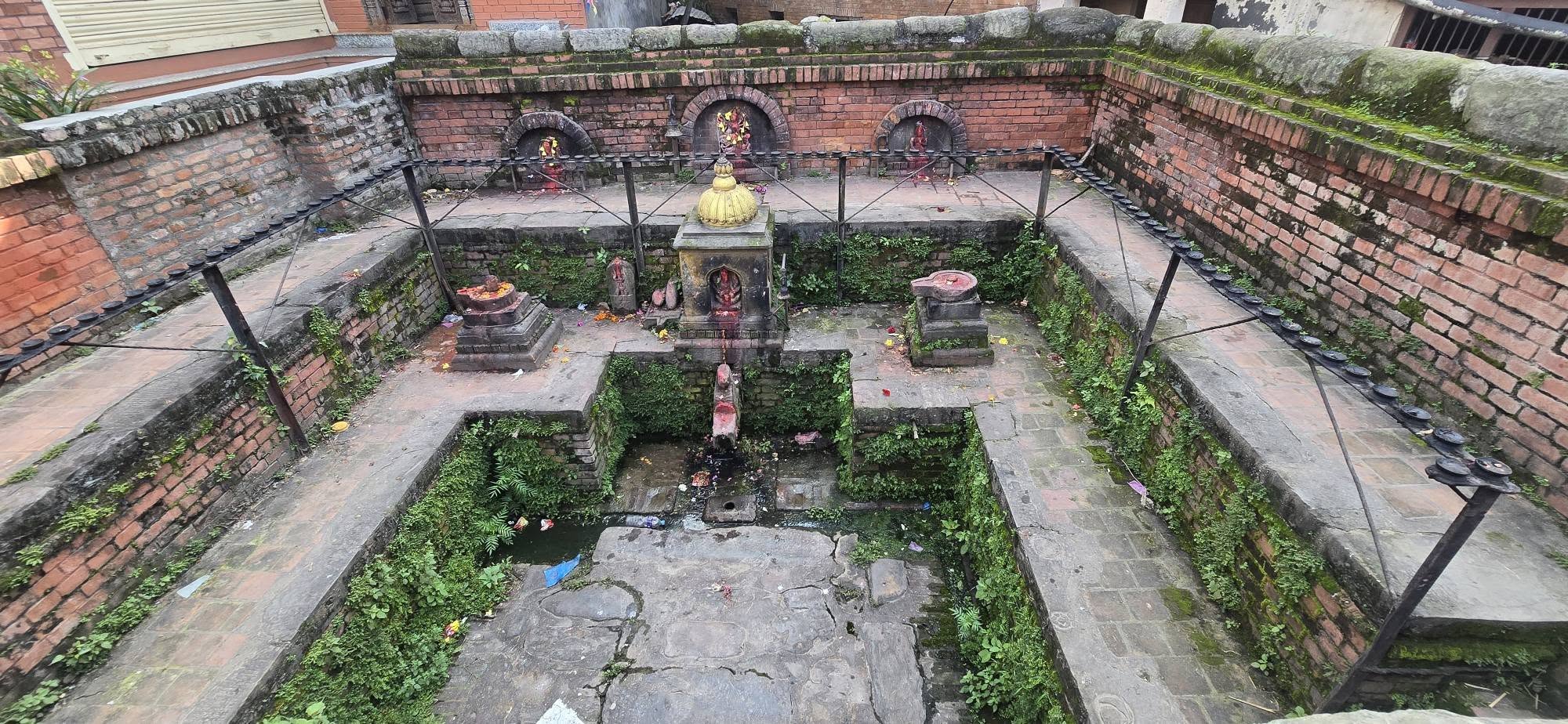
Bhaktapur — In Dekocha of Bhaktapur Municipality–6, just in front of Khwopa College, stands an old stone water spout that silently carries the history of the locality. Although water no longer flows from the traditional stone spout, it has not lost its significance. Local residents continue to clean the site and perform daily rituals, keeping alive a cultural tradition that has survived generations.
The stone spout is now surrounded by the rapidly changing urban landscape of Bhaktapur. Modern buildings, roads and other infrastructure have transformed the area, while traditional water sources have gradually disappeared from everyday life. Yet this historic structure remains a reminder of the time when stone spouts were an essential part of community life.
For local resident Rampyari Suwal, the stone spout is much more than an old structure. “Water used to flow here. People would come to collect water, and the area would remain lively. The water has stopped now, but its importance has not,” Suwal says.
According to her, the stone spout has remained connected to the memories and experiences of older generations. Before modern water supply systems reached households, traditional water sources such as stone spouts, ponds and wells were an integral part of everyday life.
“Those days were different. People used to gather around the spout. They would come to collect water and meet their neighbours. Today, water is available at home, but this place represents our history,” she says.
More Than a Source of Water
In the traditional settlements of Bhaktapur, stone spouts were not merely places to collect water. They were also social and cultural spaces where people interacted with one another. The Dekocha stone spout represents a part of that traditional way of life.
Local resident Hari Duwal believes that the disappearance of water from the spout does not mean that its historical value has disappeared. “Even though the water has stopped flowing, the importance of this place has not. It is connected to the history of the locality and to the lives of earlier generations. We need to preserve it so that future generations can understand what this place meant,” Duwal says.
He argues that physical development should not come at the cost of historical heritage. “We need development, but development should not erase history. If possible, the water source should be restored. Even if that is not possible, the structure itself should be preserved and maintained,” he says.
A Vanishing Water Culture
Bhaktapur’s traditional urban settlements were developed around an interconnected system of stone spouts, ponds, wells, temples, rest houses and other public spaces. These traditional water-management systems played an important role in sustaining community life.
Over the years, however, rapid urbanisation has changed the relationship between people and these traditional water sources.
The expansion of roads and buildings, shrinking open spaces, changes in groundwater levels and increasing dependence on modern water-supply systems have contributed to the decline of many traditional water sources.
The Dekocha stone spout is one of the visible reminders of this transformation.
There is no longer the sound of water flowing from its outlet. People no longer gather there in large numbers to fill their containers. Yet the site has not been abandoned. Local residents continue to keep the area clean and conduct religious rituals there.
“The Water Has Stopped, But the Worship Has Not”
The continued care of the stone spout by local residents reflects an important aspect of heritage conservation: community ownership.
Rampyari Suwal says that local people continue to clean the site as much as they can.
“If we do not take care of it, who will? This is our place. It is a reminder of the generations who came before us,” she says.
The fact that people continue to worship at a water source that no longer provides water demonstrates the emotional and cultural relationship between the community and its heritage.
A heritage structure does not remain alive simply because it is old. It survives when people continue to attach meaning to it.
The Dekocha stone spout appears to have retained precisely that kind of community connection.
Urban Growth and Traditional Water Sources
Bhaktapur has undergone rapid urbanisation in recent decades. Agricultural land and open spaces have increasingly been transformed into residential areas. As natural spaces for rainwater absorption disappear, traditional water systems also face increasing pressure.
For earlier generations, protecting water sources was a necessity. Today, modern water-supply systems have reduced people’s dependence on traditional spouts and ponds.
But reduced dependence does not reduce their historical and cultural importance.
In fact, restoring traditional water sources could provide both cultural and environmental benefits. Reviving old water systems, where technically and historically feasible, could contribute to groundwater recharge, heritage conservation and the preservation of traditional knowledge.
The Dekocha stone spout offers an example of why such efforts deserve attention.
A Need for Preservation and Possible Revival
Local residents hope that the stone spout can be studied and preserved properly. If technically possible, they would also like to see the traditional water system restored.
Such an effort would require research into the original water source, traditional drainage and water-flow system, and the historical structure of the spout.
Rather than replacing or altering the original structure with modern materials, conservation should focus on maintaining its traditional character.
Hari Duwal believes that conservation should go beyond simply preserving the physical stones.
“Preserving the structure alone is not enough. We also need to document and tell its history. People should know why it was built, how it was used and how it was connected to the community,” he says.
When Heritage Survives, Memory Survives
Today, no water flows from the Dekocha stone spout. But the memories associated with it continue to flow through the community.
The people who once gathered there to collect water may no longer be present, but the practice of cleaning and worshipping at the site continues. Its practical function may have disappeared, but its cultural significance remains alive.
The stone spout is therefore more than a dried-up water source. It is a witness to Bhaktapur’s changing social life and its disappearing traditional water culture.
As the city becomes increasingly modern, such heritage sites become even more valuable. Modern buildings can provide convenience, but they cannot reproduce the memories embedded in centuries-old structures. Roads can change the appearance of a city, but an old stone spout can tell the story of the city that existed before them.
The Dekocha stone spout continues to tell that story.
The next step should be to connect its preservation with the heritage and development plans of Bhaktapur Municipality. A feasibility study could determine whether the traditional water source can be revived. Regular maintenance, historical documentation and public awareness could further strengthen its protection.
The fact that local residents still clean the site and perform daily rituals, despite the absence of water, sends a powerful message: The water may have stopped flowing, but the history has not dried up—and the faith has not stopped.






Leave a Reply